








Does acupuncture work for pain? Research suggests it can help, with the strongest evidence for chronic back and neck pain, knee osteoarthritis and headaches.
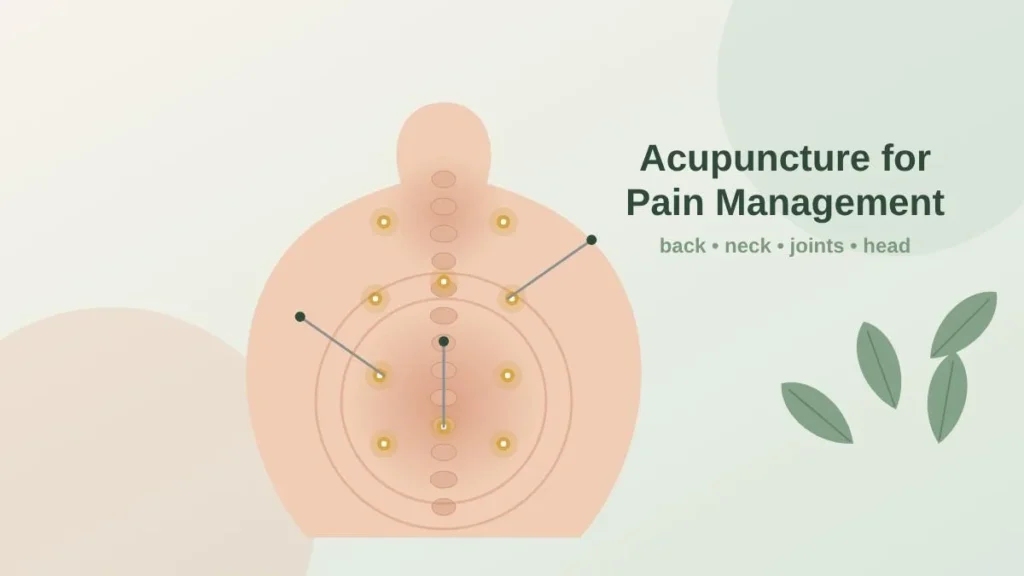
Acupuncture for pain management uses hair-thin needles at specific points to ease pain and restore movement. It is not a cure, and results vary from person to person, but large studies show effects that last for months.
This guide answers the questions patients ask most: how acupuncture helps pain, what research shows for each type of pain, how many sessions you need, and whether it is safe.
How Does Acupuncture Help With Pain?
It is thought to change how nerves signal pain and to prompt the release of the body’s own pain-relieving chemicals. Pain is one of the most common reasons people try acupuncture, and our acupuncture treatment NYC services include pain care. Knowing how needling may help makes it easier to understand what to expect.
Researchers do not fully understand how acupuncture works, but several mechanisms have been proposed. Needling stimulates nerves and muscle, which may change nerve signaling and how pain signals are processed in the brain and spinal cord.
It may also prompt the release of the body’s own pain-modulating chemicals, such as endorphins. Our guide to how acupuncture works explains these ideas in more detail.
In Chinese medicine, pain is understood as a blockage or imbalance in the flow of qi and blood. Practitioners choose points near the painful area and at distant points along the body, and the two views often overlap in practice.
Menstrual pain is one example, and our article on acupuncture for period pain covers it separately.
What Does Research Show for Chronic Pain?
Does acupuncture work for pain? The most-cited evidence comes from the Acupuncture Trialists’ Collaboration. An individual patient data meta-analysis pooled 39 trials and 20,827 patients with back and neck pain, shoulder pain, chronic headache and osteoarthritis.
It found a clinically relevant effect compared with no acupuncture, and the effects appeared to persist for at least 12 months. They were not completely explained by placebo effects.
The National Center for Complementary and Integrative Health (NCCIH) summarizes the picture. For chronic back and neck pain, a 2018 review found acupuncture beat both no treatment and sham acupuncture, and its pain-relieving effect was comparable to that of NSAIDs.
Acupuncture for arthritis pain has support too: a 2018 review found benefit over no treatment and over sham in knee osteoarthritis and other joints, and a 2019 guideline conditionally recommends acupuncture for osteoarthritis of the knee, hip or hand. In Chinese medicine for arthritis, needling is often paired with gentle heat such as moxibustion, or with herbs chosen for your pattern. Our overview of the benefits of acupuncture looks at the wider evidence.
Sham acupuncture, in which needles are inserted shallowly or at non-acupuncture points, is how researchers separate real effects from placebo. Differences between real and sham acupuncture are often modest, which is one reason the evidence is described as encouraging but not conclusive.
Not every study agrees, and the size of the benefit varies by condition. Even so, acupuncture for chronic pain is a reasonable option to discuss with your doctor, particularly when medication alone has not helped or you want to rely on it less.
Taken together, acupuncture for pain management is best viewed as a well-studied complementary option, not a stand-alone cure.
Does Acupuncture Help Back and Neck Pain?
Yes. Acupuncture for back pain and acupuncture for neck pain are the conditions with the strongest research support. NCCIH notes that a 2017 guideline lists acupuncture among the nondrug options for chronic low-back pain.
Treatment usually combines points along the spine, hips and shoulders with points on the hands and feet. Acupuncture is often used alongside stretching, strengthening and posture work, not instead of them. Practitioners look for tight muscle bands and tender points and, for neck pain, may also review posture and desk setup.
Acupuncture for shoulder pain follows the same logic, with points around the joint and along the neck, and shoulder pain was among the conditions pooled in the large meta-analysis above. Sudden severe pain, numbness, weakness in a limb, or loss of bladder or bowel control needs urgent medical attention.
Can Chinese Medicine for Arthritis Ease Joint Pain?
It may help with pain and stiffness. Research on acupuncture is strongest for knee osteoarthritis, and Chinese medicine for arthritis often combines acupuncture with herbal formulas, gentle movement and warming treatments such as moxibustion for joints that feel worse in cold weather. It works alongside your doctor’s care and does not reverse joint damage.
Can Acupuncture Help Sciatica and Nerve Pain?
It may help. Sciatica is pain that travels from the lower back down one leg, often from an irritated or pinched nerve root, sometimes called a trapped nerve. Practitioners place points along the lower back, buttock and leg to ease muscle tension and nerve irritation. The evidence for acupuncture for sciatica is smaller and less consistent than for back pain.
Practitioners may add gentle heat or electroacupuncture to calm muscle spasm along the nerve’s path. Acupuncture for sciatica works best when the cause, such as a disc problem or a tight piriformis muscle, has been identified, so bring any imaging results to your first visit.
Treatment is usually combined with movement guidance and posture advice, and you should see a doctor promptly if leg weakness, numbness or loss of bladder control appears. See our full guide to acupuncture for sciatica for session expectations and what a visit looks like.
Does Acupuncture Help Heel and Foot Pain?
It may help as part of a wider plan. Heel pain, often from plantar fasciitis, is a common reason people look for relief. It tends to feel worst with the first steps in the morning.
Practitioners treat points around the foot and lower leg, including the calf, which often feels tight when the plantar fascia is irritated. They may also suggest calf stretches, supportive shoes and a break from high-impact activity during recovery.
Evidence for acupuncture for heel pain is limited and comes mostly from small studies, so it is best considered as one part of a plan that includes stretching and supportive shoes.
Heel pain that follows an injury, or comes with swelling, redness or fever, should be checked by a doctor. Our guide to acupuncture for plantar fasciitis explains the approach in detail.
Does Acupuncture Help Migraines and Headaches?
Yes. Acupuncture has some of its best evidence in headache care. A Cochrane review of 22 trials with 4,985 participants found that adding acupuncture to symptomatic care reduced migraine frequency. Headache frequency was at least halved in 41% of people who received acupuncture, compared with 17% of those who did not.
The advantage over sham acupuncture was small. NCCIH describes the evidence as moderate quality. Acupuncture for migraines is usually considered as prevention, to reduce how often attacks occur, not as a way to stop an attack in progress.
Keeping a headache diary of sleep, hormones, food and stress helps your practitioner tailor treatment. A sudden, severe headache with fever, a stiff neck, confusion or weakness needs emergency care. Read our guide to acupuncture for migraines for more.
Does Cupping Help Muscle Tension?
Many patients feel looser after it. Cupping places suction cups on the skin over tight muscles, and it is often paired with acupuncture to ease muscle tension in the neck, shoulders and back. Practitioners say it helps loosen tight tissue, and many patients find it relaxing.
It can leave round marks that fade in days. Cups may be gently moved over oiled skin or left in place for a few minutes, depending on the goal. Tell your practitioner first if you have sensitive skin, a skin infection or take blood thinners.
Research on cupping is limited, and it should not replace medical care for a serious injury. Our guide to acupuncture and cupping explains why the two are combined and what you may notice afterward.
How Many Sessions Do You Need?
How many acupuncture sessions for pain are enough? There is no fixed number. The right number depends on the type of pain and how long you have had it. A recent injury may respond in a handful of visits, while pain that has lasted for years often needs a longer course, with spacing that gradually widens as you improve.
For context, Medicare covers up to 12 visits for chronic low-back pain, with 8 more if the first 12 help. That is a coverage rule, not a recommendation, so your practitioner will set a plan based on your response.
Factors that shape the plan include how severe the pain is, your age and general health, and how well you recover between visits.
Many practitioners reassess after a few visits. If there is no change after a reasonable trial, it is fair to ask for a different approach or a referral.
Ask how acupuncture compares with other care, since acupuncture vs physical therapy is not an either-or choice, and the two are often combined. For many people, acupuncture for pain relief works best as one part of a broader plan that includes movement, sleep and stress care.
Is Acupuncture Safe for Pain?
Acupuncture is generally considered safe when performed by a licensed practitioner, and mild effects such as soreness, a small bruise or lightheadedness can happen.
NCCIH notes that few complications have been reported, and that problems have come from nonsterile needles and improper delivery. The FDA requires that acupuncture needles be sterile and labeled for single use only.
Tell your practitioner before treatment if any of these apply:
- Blood thinners or a bleeding disorder, since bruising and bleeding can be more likely.
- Pregnancy, because some points are avoided.
- A pacemaker or other implanted electrical device, since electroacupuncture may not be appropriate.
- Any new, severe or worsening pain, which should be evaluated by a doctor first.
Acupuncture should not delay care for a health problem that needs diagnosis. Choose a licensed practitioner, and confirm that they use sterile, single-use needles.
Pain Management at Our NYC Clinic
If you are looking for acupuncture for pain NYC patients can book for chronic and acute conditions, Sage Wellness offers treatment at 139 Fulton Street in the Financial District, across from the Fulton Street subway station.
Hannah Overlock, L.Ac, provides personalized treatments for pain management and injury recovery using electroacupuncture, moxibustion, acupressure, shiatsu and herbal medicine.
Acupuncture for pain management at our clinic starts with an assessment of how your pain behaves and what provokes it, and each plan is built around your pain pattern, not a fixed protocol.
Practical advice, such as gentle exercises and posture changes you can use at home, can support treatment. To learn more about our acupuncture treatment NYC services, or to ask a question first, book a complimentary 15-minute phone call.
Related Guides
Explore our in-depth guides to specific types of pain and related treatments:
- Acupuncture for Sciatica
- Acupuncture for Plantar Fasciitis
- Acupuncture for Migraines
- Acupuncture and Cupping
Frequently Asked Questions
1. Does acupuncture work for chronic pain?
Research suggests it can help, particularly for back and neck pain, knee osteoarthritis and headaches. A large meta-analysis found effects that lasted at least 12 months and were not fully explained by placebo. Results vary from person to person.
2. How many acupuncture sessions do I need for pain?
There is no fixed number. It depends on the type of pain and how long you have had it, and your practitioner will adjust the plan as you respond.
3. Can acupuncture replace pain medication?
Not on its own for everyone. Acupuncture can be an option alongside other care, and NCCIH notes its effect on back and neck pain was comparable to NSAIDs in one review. Talk with your doctor before changing any medication.
4. Is acupuncture safe?
It is generally safe when a licensed practitioner uses sterile, single-use needles. Let your practitioner know about blood thinners, pregnancy or a pacemaker.
5. What types of pain can acupuncture help?
Research is strongest for chronic back and neck pain, osteoarthritis, shoulder pain and migraines or other headaches. It is also used for sciatica, heel pain and muscle tension, though evidence is more limited for those.
SAGE WELLNESS · FINANCIAL DISTRICT, NYC
Ready to move without pain again?
Book a free 15-minute call with Deb Valentin, L.Ac, and find out if acupuncture treatment in NYC is right for you.