









As your due date approaches, waiting can feel endless, and many women start looking for natural ways to help labor begin. Two of the most common questions are whether acupuncture to induce labor really works, and which points can be used for acupressure to induce labor at home.
In Traditional Chinese Medicine, late-pregnancy treatment is not about forcing the body. It is about preparing the body, calming the nervous system and supporting the natural process of labor once the baby is ready. This guide explains how it works, what the research says, which points are used, and how to stay safe.
Can Acupuncture Induce Labor?
Acupuncture cannot force labor to start if your body and baby are not ready. What it can do is help prepare the body for labor, often called pre-birth or labor preparation acupuncture. Treatments in the final weeks of pregnancy are used to support cervical ripening, encourage the body to move into labor naturally, ease anxiety and relieve common late-pregnancy discomforts such as back pain and pelvic pressure.
Research on acupuncture to induce labor is mixed. Some studies have found that acupuncture and acupressure may support cervical ripening and help some women go into labor spontaneously, while larger reviews have not shown a clear reduction in the need for medical induction. Many women still choose it because it is gentle, relaxing and supports them emotionally in the last stretch of pregnancy.
When to Start Acupuncture to Induce Labor
Pre-birth acupuncture usually begins around 36 to 37 weeks, with weekly sessions until delivery. Treatments aimed specifically at encouraging labor are typically given from 39 or 40 weeks, or when your provider is discussing a medical induction. Always check with your OB or midwife before starting, especially if your pregnancy is high risk.
Throughout pregnancy, our pregnancy acupuncture in NYC supports common concerns such as nausea, back pain, fatigue and stress, and prepares the body for birth in the final weeks.
Acupressure to Induce Labor: The Points Most Often Used
Acupressure uses firm finger pressure on the same points used in acupuncture, so it is something you or your partner can do at home in the final weeks. These are the points most commonly used for acupressure to induce labor (or acupressure to induce labour, as it is often spelled outside the US):
1. SP6 (Sanyinjiao)
Located on the inner leg, about four finger-widths above the ankle bone, just behind the shin bone. SP6 is one of the most widely used points to support the cervix and encourage contractions. This is why it is avoided earlier in pregnancy.
2. LI4 (Hegu)
Found on the back of the hand, in the fleshy web between the thumb and index finger. LI4 is traditionally used to help the body move into labor and to ease pain during contractions.
3. BL32 (Ciliao)
Located on the lower back, in the second small dip of the sacrum on either side of the spine. Pressure here is used to support labor and relieve lower back pain during contractions, and is easy for a partner to reach.
4. GB21 (Jianjing)
Found on the top of the shoulder, halfway between the base of the neck and the edge of the shoulder. It is traditionally used to encourage the baby to descend and to release tension.
5. BL60 (Kunlun)
Located on the outer ankle, in the hollow between the ankle bone and the Achilles tendon. It is used to support labor and ease back pain.
How to Use Acupressure at Home Safely
- Only use these points from 39 to 40 weeks, or once your provider confirms it is safe.
- Apply firm, steady pressure for one to two minutes per point, then rest, and repeat several times a day.
- Stop if you feel strong pain, dizziness, bleeding or anything that concerns you.
- Do not use these points if you have a history of preterm labor, placenta previa, bleeding or another high-risk condition, unless your provider approves.
What About a Breech Baby?
If your baby is breech in the third trimester, Chinese Medicine uses a different approach: gentle warming at the point BL67 on the little toe with moxibustion, usually between 32 and 36 weeks. This is used to encourage the baby to turn, not to start labor, and should be guided by a licensed practitioner.
What to Expect in a Labor Preparation Session
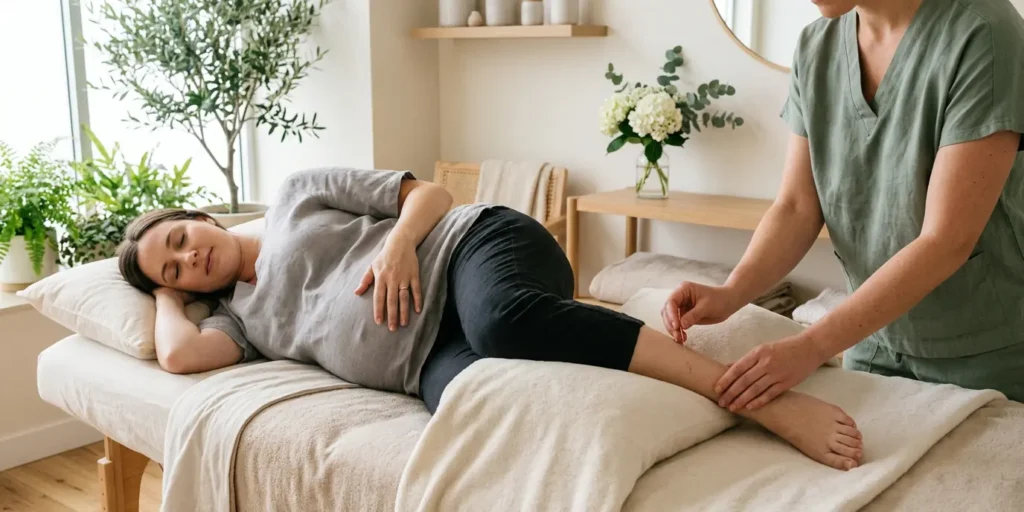
Your practitioner will check how many weeks you are, how you are feeling and what your provider has recommended. You will rest comfortably, often on your side with pillows, while fine needles are placed at points on the legs, hands and lower back. Many women find these sessions deeply calming, which matters, since stress and fear can slow labor down.
Acupuncture can also be continued after birth to support postpartum recovery. Read more about acupuncture and pregnancy and how Chinese Medicine supports each trimester.
Frequently Asked Questions About Acupuncture to Induce Labor
Does acupuncture to induce labor work?
Acupuncture cannot force labor, but it may help prepare the body by supporting cervical ripening and relaxation. Research results are mixed, so it is best seen as a gentle, supportive option alongside your medical care.
When can I start acupressure to induce labor?
Most practitioners recommend waiting until 39 to 40 weeks and checking with your OB or midwife first. Points like SP6 and LI4 are avoided earlier in pregnancy.
Which pressure points help induce labor?
The points most often used are SP6 on the inner leg, LI4 on the hand, BL32 on the lower back, GB21 on the shoulder and BL60 on the outer ankle.
Is acupuncture safe in late pregnancy?
Yes, when performed by a licensed acupuncturist experienced in pregnancy care. Your practitioner will adapt the points and positioning for each stage of pregnancy.
How many sessions do I need before labor?
Pre-birth acupuncture is usually weekly from around 36 to 37 weeks until delivery, with sessions closer together once you reach your due date.