





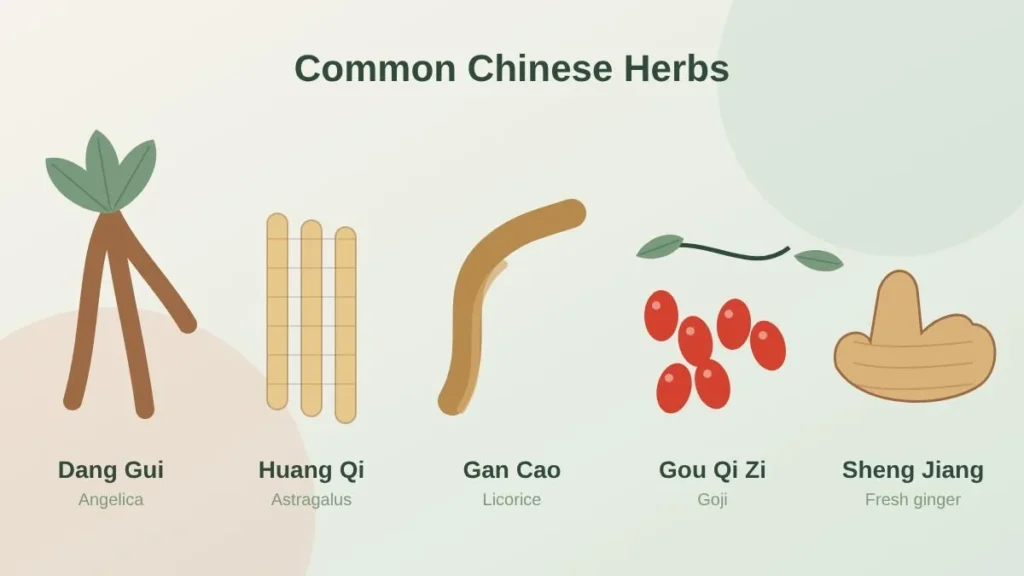
What are the most common Chinese herbs? Five of the most widely used are dang gui, huang qi (astragalus), gan cao (licorice), gou qi zi (goji berry) and sheng jiang (fresh ginger).
Chinese herbs, often called Chinese medicine herbs, are rarely taken alone. A licensed practitioner combines them into formulas matched to your pattern, not just your symptom.
This guide explains how formulas work, what each of these herbs is traditionally used for, who should avoid it, whether Chinese herbs are safe with your medications, and how a practitioner chooses the right herbs for you.
How Do Chinese Medicine Herbs Work?
Most Chinese herbs are prescribed in combinations, not one at a time. A formula balances several herbs so they support each other and soften each other’s side effects. Our Chinese herbal medicine NYC consultations are built around this idea.
A formula is chosen through pattern diagnosis. Your practitioner asks about your symptoms, digestion, sleep, energy and cycle, then checks your tongue and pulse to decide which pattern fits you best. To see how this thinking fits into the wider system, read what traditional Chinese medicine is.
Classic formulas often have a main herb that targets the central problem, supporting herbs that help it work, and a harmonizing herb that blends the whole. That is why one herb in this list may appear in dozens of formulas for very different conditions.
Learning about single herbs is still useful, which is why the sections below describe each one on its own. Just remember that your own formula may contain a different mix, in different amounts.
Dang Gui (Angelica Root): A Blood Tonic for Women
Dang gui is the root of Angelica sinensis, also sold as dong quai. In Chinese medicine it is a blood tonic, traditionally used for menstrual concerns such as cramps and irregular cycles, and it is among the best known Chinese herbs for women.
We cover it in more depth in our dang gui guide, and a related article explains how Chinese herbs for fertility are used.
The research is modest. Memorial Sloan Kettering Cancer Center (MSK) describes the evidence for menopausal symptoms as inconclusive.
Who should avoid it: pregnant or breastfeeding women, people taking blood thinners such as warfarin, and anyone with a hormone-sensitive condition unless their doctor agrees. Dang gui can also make skin more sensitive to the sun.
What Is Huang Qi (Astragalus) Used For?
Huang qi is the root of astragalus, a classic qi tonic. Traditionally it is used to support energy and resistance to colds, which makes it one of the Chinese herbs for energy practitioners reach for most often.
Human research is limited. MSK notes that clinical data are limited and that many studies were poorly designed, so huang qi is best seen as a traditional herb with early evidence, not a proven treatment.
Who should avoid it: people taking immunosuppressant drugs, since astragalus may make them less effective. It may also lower blood pressure and raise bleeding risk with blood thinners, so check with your prescriber first.
What Is Gan Cao (Licorice Root) Used For?
Gan cao is licorice root, and it is one of the most widely used harmonizing herbs in Chinese formulas. It is added to soften harsh herbs and to ease the stomach.
Licorice contains glycyrrhizin, which at high doses makes the body hold on to salt and water and lose potassium. The MSD Manual notes that this can raise blood pressure and lower potassium levels.
Who should avoid it: people with high blood pressure or heart disease, those taking digoxin or potassium-lowering diuretics, and pregnant women. Long-term use should be supervised by a professional.
What Is Gou Qi Zi (Goji Berry) Used For?
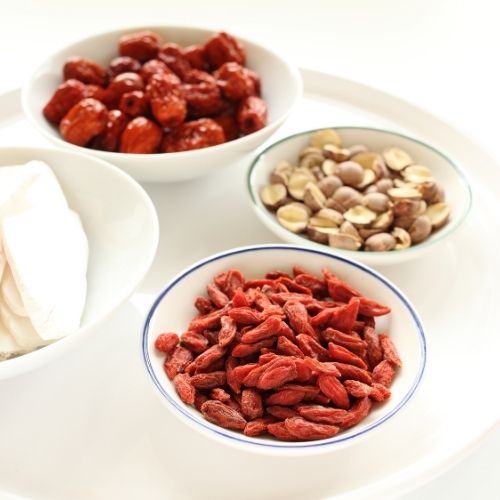
Gou qi zi is the goji berry. In Chinese medicine it is often combined with other herbs for poor vision and general vitality. It is also the herb most likely to show up in your kitchen as dried fruit or tea.
MSK states that the safety and efficacy of goji for chronic diseases has not been established. Small human studies hint at benefits for blood sugar or cholesterol, but the data are limited.
Who should avoid it: people on warfarin or other anticoagulants, because elevated INR and bleeding have been reported after goji products. People with plant-food or pollen allergies should also be careful.
What Is Sheng Jiang (Fresh Ginger) Used For?
Sheng jiang is fresh ginger, a warming herb used in Chinese medicine to ease nausea and to support a sluggish stomach. It appears in many formulas, and it is one of the Chinese herbs for digestion that people already know from cooking. Our guide to Chinese herbs for gut health shows how it fits into digestive formulas.
MSK notes that ginger may help relieve nausea, though larger studies are still needed. Culinary amounts are different from concentrated supplements.
Who should avoid concentrated ginger: people who take blood thinners, since ginger supplements may raise bleeding risk, and people with bleeding disorders or gallstones. MSK advises stopping ginger supplements about two weeks before surgery and avoiding them during pregnancy or breastfeeding.
Are Chinese Herbs Safe?
Chinese herbs are generally well tolerated when they are prescribed correctly, but they are not risk-free. Herbs can act like medicine, and drug interactions are possible. Think of this Chinese herbs list as a starting point for a conversation, not a shopping list.
Work with a licensed herbalist or practitioner. The National Center for Complementary and Integrative Health (NCCIH) advises asking about a practitioner’s training and experience and telling all your health care providers what you take.
Share every medication and supplement you use. NCCIH also warns that some Chinese herbal products have been found to contain undeclared drugs such as warfarin and diclofenac, or heavy metals such as arsenic, lead and cadmium. Sourcing herbs through a licensed practitioner may lower that risk.
Start only one new herbal product at a time so any side effect is easy to trace. Stop and call your practitioner if you notice a rash, palpitations, unusual bleeding or stomach upset.
Pregnancy needs special care. Several herbs listed here are advised against during pregnancy, so tell your practitioner if you are pregnant or trying to conceive.
How Does a Practitioner Choose Your Herbs?
The visit starts with your history, your symptoms and your goals. Your practitioner then looks at your tongue and pulse to refine the pattern. Our guide to what your tongue says about your health explains why the tongue matters.
From there, you receive a formula, not a single herb. Chinese herbal formulas may be adjusted as your symptoms change, and your practitioner will review progress with you.
Herbs work best as part of a broader plan. Your practitioner may pair them with acupuncture, food guidance, and sleep and stress habits, and will ask how you feel after each change.
If you want to know how to take Chinese herbs, your practitioner will explain the form, timing and what to expect. To start with a consultation, see our Chinese herbal medicine NYC page or book a complimentary 15-minute phone call with our team. The clinic is at 139 Fulton Street in the Financial District.
Frequently Asked Questions
1. What are the most common Chinese herbs?
Five of the most common are dang gui, huang qi, gan cao, gou qi zi and sheng jiang. They are usually prescribed within formulas, not one at a time, so the right herbs for you depend on your pattern.
2. Are Chinese herbs safe?
They can be safe when prescribed by a licensed practitioner who knows your health history and medications. Risks include herb-drug interactions, pregnancy cautions and poor-quality products with contaminants.
3. Can I take Chinese herbs with my medications?
Not without checking first. Tell your practitioner and your doctor about every medication and supplement you use, since several herbs, including astragalus, dang gui, licorice and goji, can interact with common drugs.
4. How long do Chinese herbs take to work?
It varies. Some people notice changes within a few weeks, while long-standing concerns can take longer, and your practitioner will review your progress and adjust the formula.
5. Do Chinese herbs come as tea, powder or capsules?
Yes. Herbs can be simmered into a tea, dissolved from powdered granules in hot water, or taken as capsules or tinctures. Your practitioner will recommend the form that fits your formula and your routine.
SAGE WELLNESS · FINANCIAL DISTRICT, NYC
Wondering which herbs fit you?
Book a free 15-minute call with Deb Valentin, L.Ac, and find out if Chinese herbal medicine in NYC is right for you.